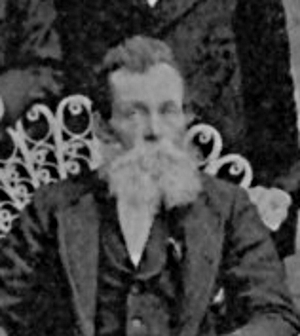
(FindAGrave)
Daniel W. Boutwell mustered into service as a private in Company A, 5th Kansas Cavalry, on July 16, 1861, at Fort Leavenworth for three-years service. Boutwell was reported “absent without remark” on the company rolls in December 1861. From January 1 to April 30, 1862, Boutwell was reported “absent in arrest at Fort Scott, Kansas.” In May and June 1862, Boutwell was reported “deserted from the custody of guards at Fort Scott, Kans., March 18, l862, having been sentenced to hard labor by court-martial.”
I bet you're wondering why we have written a biographical sketch for this individual. Well, he did play a key role in volunteering to carry a message through enemy lines for Maj. Gen. Alfred Pleasonton. Boutwell succeeded and now both Curtis and Pleasonton new they had to press their advantage against the Confederate army. He later described what he did, although a bit odd in referring to himself in the third person.
"He received his instructions from General Deitzler, and without papers or arms, dressed in the army uniform, left the General’s headquarters on the Blue, about 7 o’clock at night and rode to Kan-sas City. Leaving his horse there he took a skiff and started down the river, but had not proceeded but a few miles, when his boat stuck on a bar and he was compelled to abandon it. He made his way to the shore the best way he could, and now found that he had reached the rebel lines and was fired upon by the pickets, the ball passing but a few inches from him. Carefully concealing himself in the brush, he moved stealthily along and passed the pickets. From this point, he went above the lower ford of the Big Blue, which was held by the rebels, and finding the mud very deep, threw in rails and lying down attempted the passage. About half way over he slipped off the rails and was immersed in mud, thin and slimy, three or four feet deep. By dint of hard work and perseverance, he succeeded in reaching the other side, and passed on by Independence, carefully avoiding roads, pickets and guards. About daylight, four miles below Independence, he came within sight of the rear of Price’s army, five thousand strong, left to oppose Pleasanton.
"Passing to the left of this, he had proceeded but a few miles through the timber, when he was ordered to halt, and turning, saw three men with guns drawn on him. They beckoned for him to come up, and asked who he was. He replied, that he supposed he was their prisoner. They examined his uniform and wished to know if he was a federal soldier. He replied, that he was, and much to his surprise was told he was 'all right then.'
"These three men proved to be George Smiley, and two other members of the Rush Bottom Company of Missouri State Militia, who had been cut off from their command the day before, in the fight with Blunt at the Little Blue, and had not been able to get out of the rebel lines. One of these guided our hero on through the country four or five miles and took him to a house, where he was furnished breakfast. A short time after he left this man, he came within sight of the rebel pickets, and evading them passed to one side, one of the rebel pickets coining within twenty yards of him. When nearly opposite them, Pleasanton’s pickets commenced firing upon the rebels. After the firing had ceased, Boutwell went up to the road, but seeing no one, and the tracks showing the federals had advanced, he proceeded toward the main army. He had travelled about a mile, when he met a soldier who conducted him to the General's Headquarters, at the ford of the Little Blue [River]. The army was moving slowly along, intending to camp soon for the day. Boutwell was introduced to the presence of Generals Pleasanton, McNeil and Sanborn.
"Boutwell asked the Generals if they “would receive a verbal message from a muddy man.” Pleasanton replied that he would, and he proceeded to deliver his message. The General examined, re-examined and cross-examined his informant, until fully satisfied of the correctness of his statements, and said that he had been ready to attack for several days, and not having heard anything from above, and realizing that it was slow business to organize militia, feared that they were not ready for him to move."
After the war, a bill was submitted before the 52d Congress on Boutwell's behalf. Here are excerpts from the report of the US Senate Committee on Military Affairs.
"The bill proposes to authorize the payment to Daniel W. Boutwell of $10,000 for extra hazardous service rendered the Government of the United states during Gen. Price’s invasion of Missouri and Kansas in October, 1864. ...
"The 'extra hazardous service' for which $10,000 is claimed, is said to have been performed by Boutwell after he was mustered out of the United States service and while he was serving in the Kansas militia, as set forth in a brief filed with the bill. This service consisted in carrying a dispatch from Gen. Deitzler, in command of the militia, through the rebel lines, to Gen. Pleasanton, during Gen. Price’s raid in Kansas, and it is claimed that thereby the State of Kansas was saved from being devastated.
"While it is not denied or affirmed that Boutwell performed the service, the committee would suggest that if the doors of the United States Treasury were opened to all claims for 'hazardous service' performed by persons during the late war. tbe amount required to pay them would be incalculable. If the Government felt itself bound to pay this claim, and thereby set a precedent, it would be unfair not to pay the thousands of cases of like character of as much merit as this. Under these circumstances your committee can not consent to single out this case as against all the others, and therefore feel warranted in reporting the bill adversely, and recommend its indefinite postponement."
“A Veteran’s Fight for Justice Ends.” The Topeka Daily Capital. November 19, 1912.
“52d Congress, 1st Session, Senate Report No. 659.” In Reports of the Committees of the Senate of the United States for the First Session of the Fifty-Second Congress.
Hinton, Richard J. Rebel Invasion of Missouri and Kansas, and the Campaign of the Army of the Border against General Sterling Price, in October and November, 1864. Chicago: Church & Goodman, 1865.