
Find out about the Enfield Rifle Musket on display by clicking/pressing the play button. Scroll down to view the images. At the end there is a video demonstrating the loading and firing of an Enfield Pattern 1853 Rifle Musket. You can follow along with the audio's script at the end of the page.
Enfield Pattern 1853 Rifle Musket (Wikimedia Commons)
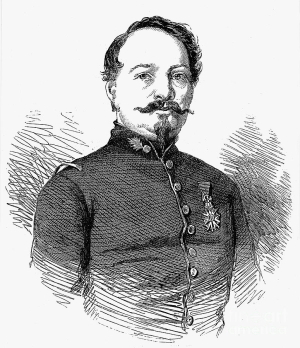
Claude-Étienne Minié (Wikimedia Commons)

Percussion Caplock with Percussion Caps (Wikimeida Commons)
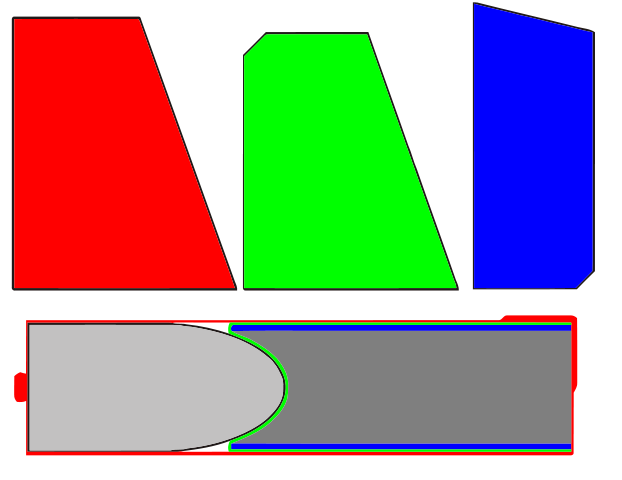
Enfield Paper Cartridge Construction (Wikimedia Commons)
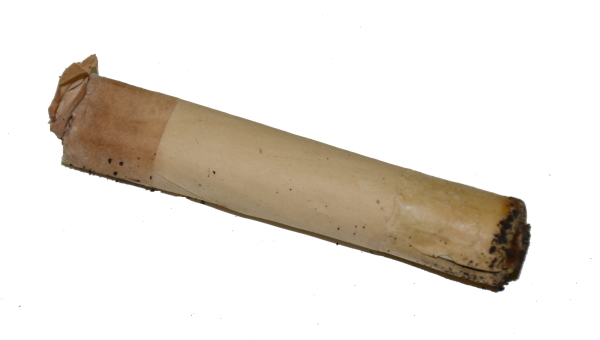
Enfield Paper Cartridge, .577 Caliber (Battle of Westport Museum)
This is a short YouTube video (produced by britishmuzzleloaders) of loading and firing an Enfield Pattern 1853 Rifle Musket using paper cartridges.
This is a short YouTube video (produced by britishmuzzleloaders) of how an Enfield paper cartridge is constructed.
The Enfield rifle musket on display is a non-firing replica of the Enfield Pattern 1853 Rifle Musket. This was one of the most popular weapons used during the Civil War, second only to the Springfield Model 1861 Rifle Musket. Many of the Confederates who fought in the Battle of Westport carried the Enfield rifle musket. During the war, Confederates imported more of these rifle muskets than any other type.
In the early 19th century, there were two basic types of long guns, the rifle and the musket. As its name suggests, the barrel of the rifle had a rifling pattern which imparted a spin on the bullet. Much like spiraling an American football, the spin made the rifle more accurate at longer distances. The smoothbore musket’s barrel was shorter with no rifling. The musket was really only accurate to 100 yards whereas a rifle could be accurate up to 1000 yards.
However, the underlying tactical issue between these two long guns was rate of fire. Muskets could be loaded and fired much more quickly than a rifle. A inside diameter of a musket’s barrel was larger than the musket ball’s diameter. Conversely, the inside diameter of the rifle’s barrel was barely larger than the bullet’s diameter. When fired, the rifle’s bullet had to engage the barrel’s rifling. It was harder to ram the bullet down the rifle’s barrel. And it became increasingly harder as fired gunpowder residue fouled the barrel.
This problem was solved when Claude-Etienne Minié invented the rifled musket and the expanding bullet. Feel free to pick up one of the replica Minié or “Minnie” balls on top of the display cabinet. Like the musket ball, this new “ball’s” diameter was smaller than the inside diameter of the rifle-musket’s barrel. The but end of the Minnie ball was hollow. When the rifle-musket was fired, the explosion expanded the skirt of the bullet which then engaged the barrel’s rifling. The conical bullet came out of the barrel spinning like a regular rifle’s bullet. Rifle muskets long distance accuracy approached 500 yards but could be loaded much more quickly than a rifle could.
The Enfield Pattern 1853 rifle-musket was a .577 caliber Minié-type muzzle-loading rifled musket. After loading the powder and ball, a percussion cap (feel free to pick up one of the spent percussion caps on top of the display case), was placed on the nipple beneath the gun’s hammer. A percussion cap was a copper or brass cylinder which was closed at one end and filled with a friction-sensitive explosive, such as fulminate of mercury. When the gun’s hammer hit the percussion cap the explosion ignited the gunpowder.
This rifle-muskets, along with the similar Springfield, used “paper” cartridges. A piece of heavy gauge paper was shaped into a tube in which a measure of black powder was poured. Then a Minié ball was wrapped into the cartridge. Fairly simple, but useless if the cartridge got wet.
As you might predict from reading the steps to load and fire a rifle-musket, a soldier could fire at a rate of maybe 2-3 rounds per minute.
Grab paper cartridge from cartridge box.
Use your teeth to tear paper tip of cartridge.
Empty gunpowder into the barrel of the gun.
Remove the ball from the paper and drop it into the barrel.
Return the rammer home.
Grab a percussion cap from cap box, pull hammer to half cock, remove spent percussion cap and place fresh percussion cap on nipple.
Bring the rifle musket to your shoulder and pull hammer to full cock.
Aim and then fire the weapon.
Hardee, William Joseph. Hardee’s Rifle and Light Infantry Tactics. Memphis, TN: E.C. Kirk & Co., 1861.
Hess, Earl J. Civil War Infantry Tactics: Training, Combat, and Small-Unit Effectiveness. Baton Rouge, LA: Louisiana State University Press, 2015.
Wikipedia. “Pattern 1853 Enfield,” December 6, 2021. https://en.wikipedia.org/wiki/Pattern_1853_Enfield.
Wikipedia. “Percussion Cap,” January 11, 2019. https://en.wikipedia.org/wiki/Percussion_cap.
Walter, John. The Rifle Story: An Illustrated History from 1756 to the Present Day. St. Paul, MN: MBI Publishing, 2006.
Written and produced by Dick Titterington, aka theCivilWarMuse.