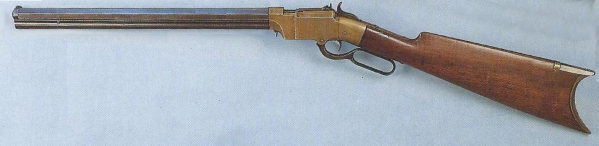
Find out about the Model 1860 Henry Rifle on display by clicking/pressing the play button. Scroll down to view the images. At the end there is a YouTube video about loading and firing the Model 1860 Henry Rifle. You can follow along with the audio's script at the end of the page.
Volcanic Repeating Rifle, forerunner of the Henry Rifle (Wikimedia Commons)
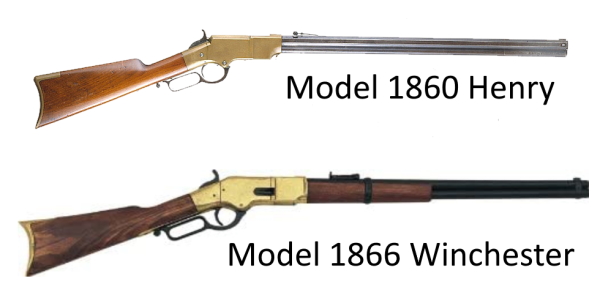
Model 1860 Henry Rifle and Model 1866 Winchester (Wikimedia Commons)
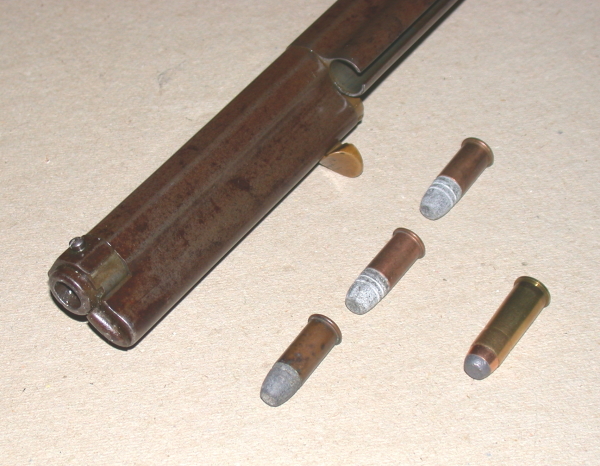
Model 60 Henry rifle, magazine open for loading; 3 Henry rounds, one round 44-40 to compare (courtesy of Hmaag from Wikimedia Commons)
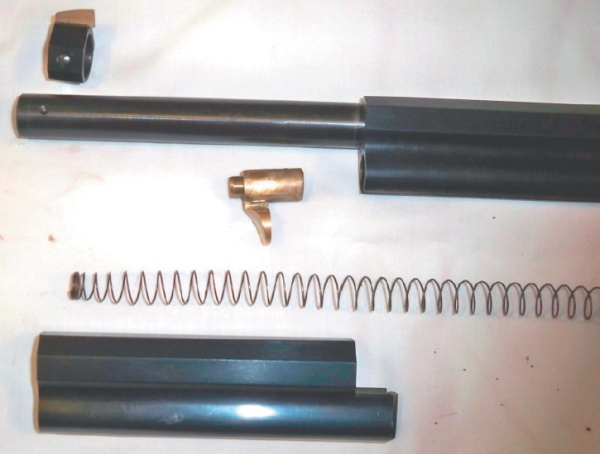
Model 60 Henry rifle, magazine parts (Wikimedia Commons)
This is a 23-minute YouTube video (produced by Hickok45), but the first 5 minutes demonstrates the loading and firing of the Model 1860 Henry Rifle.
The repeating rifle on display at the museum is actually a non-firing replica of the Winchester Model 1866 repeater. But it is similar in appearance to the Model 1860 Henry Rifle that was used to great effect by volunteer cavalry units in the Federal Army of the Border. The main difference is the presence of a loading gate on the on the side of the frame and integrating a sealed magazine which was covered by a fore stock. This corrected the issue of dirt contaminating the tubular magazine which was open to the elements. It also corrected the problem of a shooter holding the magazine/barrel after it got hot with repeated firing. The Model 1860 Henry was loaded by moving the cartridge-follower, a metal tab connected to a spring, along the slot into the top portion of the magazine-tube and pivoted it to the right to open the front-end of the magazine. Then cartridges were loaded into the tubular magazine. To better understand the operation of the Model 1860 Henry, watch the first five minutes of the video at the bottom of the page.
The Henry had its origins in a company found in 1855 by partners Horace Smith and Daniel B. Wesson to develop firearms based on one of the earliest repeating rifles, the Volcanic Repeating Rifle, designed by Walter Hunt. The Volcanic Repeating Arms Company produced an improved version of Hunt’s “Rocket Ball” cartridge to be used in an improved, lever action carbine and pistol. Volcanic was never a viable company, but many of you will recognize its descendants, the Winchester Repeating Arms Company and Smith & Wesson.
In 1857, Oliver Winchester acquired ownership of the Volcanic Repeating Arms Company and moved it to New Haven, Connecticut, renaming it the New Haven Arms Company. It was here that B. Tyler Henry, hired by Winchester as plant superintendent, began work on improving the metallic cartridge and the carbine’s lever action. In 1860, Henry’s work (US Patent 30446) resulted in a repeating rifle that fired a copper (later brass), .44 caliber rimfire cartridge. There were 15 cartridges loaded into a spring-loaded, tubular magazine that fit under the rifle’s barrel. The US War Department purchased 1,731 Henry rifles. The Henry cost the government $36.95 each and a box of 100 cartridges cost $2.33. Another 9,000 or so were purchased by private individuals, many by veterans who used their reenlistment bounties.
Although the Henry rifle did not pack as large a punch as the Spencer carbine, it had a rapid rate of fire. Opening the trigger guard lever ejected the spent cartridge, loaded a fresh cartridge, and cocked the hammer. After that the soldier only had to pull the trigger to fire the gun.
Written and produced by Dick Titterington, aka theCivilWarMuse.