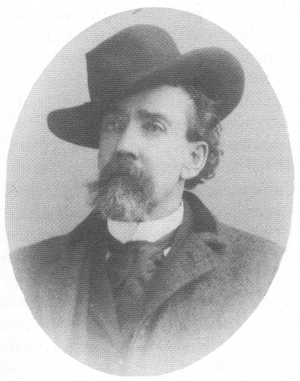
Born in Mason County, Kentucky in 1841, Richard A. Collins moved to Lafayette County, Missouri, in 1857. Collins joined the 2d Missouri Light Artillery (CSA) in April 1862 and was commissioned a 1st lieutenant. Capt. Joseph Bledsoe commanded the battery. The battery saw its first service during the First Battle of Newtonia in September 1862. Later that same year, the battery fought at Cane Hill and Prairie Grove. Lieutenant Collins comanded a section of the battery during Brig. Gen. John S. Marmaduke's first cavalry raid into Missouri in January 1863, fighting at Springfielda and then Hartville. Later that year, both sections went on Marmaduke's second raid into Missouri, fighting at Cape Girardeau and Chalk Bluff. Then on July 4, 1863, the battery fought in the Battle of Helena, Arkansas. When Captain Bledsoe resigned his commission in December 1863, Collins was promoted to captain and took over command of the battery. The battery participated in the Camden Expedition and was instrumental in the attack and capture of the Union tinclad gunboat, Queen City, on the White River near Clarendono, Arkansas.
During the Battle of Westport, Capt. Richard A. Collins was in command of two sections (four 10-pounder Parrott Guns) from his battery. On October 23, Collins engaged in an artillery duel with McLain’s Independent Battery, Colorado Light Artillery. Collins got the worse of the duel, losing one of his guns to the Federal artillery fire. Then later that morning Shelby’s position was flanked to the west by the Union commander General Curtis. Collins immediately wheeled his guns to the west and did battle with the artillery from the 9th Wisconsin Battery that Curtis had brought with him on his flanking maneuver. Thompson reported that one of the Parrot Guns in Collins’s battery burst during this artillery duel. Beset with bad karma, Collins finished the day with only one of his four guns still in operation. With his one remaining gun, Collins supported Col. Sydney D. Jackman's rear guard action behind the stone wall that came to be known as "Shelby's Last Stand."
One of the more bizarre facts about the Collins's battery was its pet black bear, who they named Postelwait. The bear was known to wander around the Confederate encampment at night rummaging for food. It also reportedly rode into battle on the footboards of a limber. While Price's army rested in Boonville, the men in Collins's command used their per bear to entertain the citizens of Boonville.
After the war, Collins settled in Higginsville, Missouri, and resumed his law practice. Apparently "Capt. Dick" did not like dicussing or reading about his wartime experiences. In the History of Lafayette County, there is the following passage in his brief biographical sketch:
"A whole chapter might be devoted to the gallant “ Capt. Dick,” and his exploits during the war, but for want of space and in consequence of an injunction served upon us by the captain himself, we will have to desist."
McGhee, James E. Guide to Missouri Confederate Units, 1861-1865. Fayetteville, AR: University of Arkansas Press, 2008.
Missouri Historical Company. History of Lafayette County, Mo. St. Louis: Missouri Historical Company, 1881.
Sinisi, Kyle S. The Last Hurrah: Sterling Price’s Missouri Expedition of 1864. Lanham, MD: Rowman & Littlefield, 2016.
Titterington, Dick. The Battle of Westport, October 21–23, 1864: A Driving Tour of Battle Sites in Kansas City, Independence, and Northeastern Jackson County, Missouri. Overland Park, KS: Trans-Mississippi Musings Press, 2019.