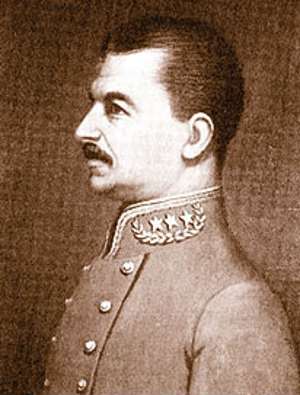
Born in South Carolina, George Colton Greene relocated to St. Louis, Missouri, during the 1850s. By 1860, Greene had become a successful wholesale grocer and was a partner in the Hoyt & Co. law firm. Greene was in favor of Missouri secession, served as an aide to Missouri Governor Claiborne Fox Jackson, and along with Basil Duke, established the paramilitary Minute Men organization in St. Louis. On Jackson’s behalf, Greene and Duke traveled to Montgomery, Alabama, in April 1861, to meet with Confederate President Jefferson Davis and ask for Davis’s help in obtaining arms. In June 1862, Greene was authorized to raise a regiment and was commissioned colonel of the 3d Missouri Cavalry (CSA) as a result.
During the Battle of the Little Blue River, Colonel Greene's regiment fought the Federal 11th Kansas Cavalry under Col. Thomas Moonlight, at point blank range, to a standstill. But then Greene ordered his artillery to open fire using blanks. Greene was wounded during the fighting and later described the action.
"I dismounted about 150 men, formed across the road, and imme-diately engaged the enemy, who was right upon us. Williams’ three-gun battery was unlimbered fifty yards behind my regi-ment. The enemy, who was in greatly superior force, vigorously pressed his advantage. He was twice repulsed, when he began to flank me both on the right and left. The moment was critical; no supports arrived. Directing my wings to fire by the right and left oblique I took charge of the battery, firing Nos. 1 and 3 on my flanks, and then ordered rapid volleys of blank cartridges to be fired (the position of my men prevented the use of missiles). It produced the desired effect. The enemy fell back and was charged by us. He now rallied and opened with artillery; again advanced and was again repulsed. The fight was thus continued between unequal numbers, my ammunition was exhausted, the fortitude of my men severely tried, when Kitchen’s regiment reached the field. I put it into line and directed it to fire by volley. The enemy fled to return no more."
After the war, Greene returned to St. Louis and found his law partner had seized his business interests. So, Greene moved to Memphis, Tennessee, and started working in banking and insurance. In time, Greene started his own insurance business and established the State Sav-ings Bank of Memphis.
Titterington, Border State Contest: Civil War Comes to Missouri in 1861, 40, 75-77.
Allardice, More Generals in Gray, 105-106.
OR s1 v41 p1 687-692.
Wikipedia. “Colton Greene,” July 26, 2020. Link.
McGhee, Guide to Missouri Confederate Units, 1861-1865, 64-68.