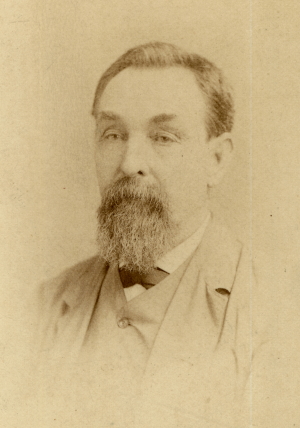
(Missouri Historical Society)
Born in Kentucky, Sydney Drake Jackman moved with his family to Missouri in 1830. As an adult, Jackman found work as a teacher and also did some farming. Jackman moved to Bates County in 1855 where he organized local militias to fend off Jayhawker incursion from Kansas Territory. Near the start of the Civil War, Jackman joined the Missouri State Guard. In 1862, Jackman was recruiting in Missouri to raise a regiment for the Confederate States Army and took part in the Battle of Lone Jack. Jackman returned to Arkansas with enough recruits to organize the 16th Missouri Infantry (CSA). Jackman was appointed colonel of this regiment but resigned shortly thereafter to return to Missouri for additional recruiting. While in Missouri recruiting, Jackman led his band of irregular cavalry using guerrilla tactics against Union authorities. In 1864 when Jackman returned to Arkansas with these recruits, they were organized into Jackman’s Missouri Cavalry and assigned to Shelby’s command.
During Price's 1864 Missouri Expedition, Jackman's Brigade served in Shelby's Division. On October 21, Jackman's Brigade reinforced the Confederate attack at the Little Blue River. Then on October 22, Jackman began the day by feinting an attack at the Main Crossing over the Big Blue River while the primary attack was being made at Byram's Ford. Once the Confederates gained control of Byram's Ford, Shelby ordered Jackman to cross and head for Russell's Ford. On the way there, Jackman's Brigade ran into the 2d Kansas State Militia. It took a few charges against the Kansas militiamen, but Jackman eventually gained control of the filed at Mockbee Farm.
On October 23, Jackman led his bridgade during the fighting just south of Brush Creek, holding the position on Shelby's left flank. Around noon when his right flank was threatened by Maj. Gen. Alfred Pleasonton's artillery, Shelby ordered Jackman to reposition his brigade against this new threat. Colonel Jackman was able to slow down the Federal attack on the Confederate right, while Shelby proceeded to fall back south toward the wagon train. Now the Confederates were being pressed by the combined forces of Generals Blunt and Pleasonton. As the Confederates fell back, Jackman was ordered to fight a rear guard action. Ffortunately for Jackman there was a long stone wall close by, and he quickly deployed his men behind the wall. Supported by Capt. Richard A. Collins and his one remaining 10-pounder Parrott gun, Jackman used this strong defensive position to hold off the Federal attacks. By 2:00 p.m., the Federal attack slackened, and Jackman withdrew south toward the wagon train.
Col. Sydney D. Jackman, commanding Jackman’s Brigade, described his men’s rearguard action while the Confederate army was retreating from Westport.
"About 12 o’clock I received an order from General Shelby to fall back across the prairie to the point where the gun was captured the evening before and report to General Fagan, who was in pressing need. I immediately moved out, and on the way met an order from General Fagan to move as rapidly as possible, as the enemy were demonstrating in heavy force on his front. Upon reaching the general I was ordered by him to dismount my men and receive a charge of the enemy’s cavalry. I formed my men on foot and directed them to withhold their fire until the Federals were in point-blank range.
"In the meantime they came on in a swinging trot, and when within eighty yards at the command a destructive fire was poured into them, killing and wounding a large number of men and hors-es, and causing their line to reel and break. The line of the enemy being much longer than ours, their right continued to advance, but turning and pouring a well-directed fire into it, it fell back in confusion. By this time the enemy were covering the prairie, threatening from every point, and my horses being exposed I or-dered my men to mount. After mounting we formed a number of times in falling back and took position until the enemy disap-peared, when I moved off in the rear of the army. During this last engagement, Captain Collins, of the battery of General Thomp-son’s brigade, came to my assistance with his only remaining gun and fought gallantly until the command fell back.
"In this fight my brigade, although placed in a perilous condition, on foot, and threatened by superior numbers, behaved with a steadiness and courage beyond common praise. A considerable loss was sustained by the brigade in the various engagements of these two days; some 25 men were killed and 80 wounded."
At the end of the war, Jackman settled in Texas where he served in the state legislature and then was appoint U.S. Marshall by President Grover Cleveland.
Jackman, Behind Enemy Lines: The Memoirs and Writings of Brigadier General Sidney Drake Jackman. 3-9.
“Col. Sydney Jackman.” Confederate Veteran 19 (1911): 436.
McGhee, Guide to Missouri Confederate Units, 1861-1865, 120-121, 233-237.
OR s1 v41 p1, 671-678.
Wikipedia. “Sydney D. Jackman,” October 18, 2019. https://en.wikipedia.org/wiki/Sidney_D._Jackman.