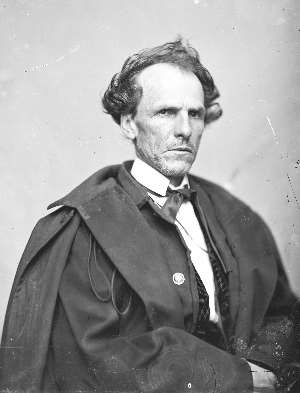
(Library of Congress)
James Henry Lane was born on June 22, 1814 in Lawrenceburg, Indiana, the son of an Indiana politician. After working at a variety of jobs, Lane studied law under his father and was admitted to the bar in 1840. After serving in the War with Mexico as a Col. of Volunteers, Lane returned to Indiana to enter politics. In 1852 running as a Democrat, Lane was elected to represent the Fourth District of Indiana in the U.S. House of Representatives. Lane was undistinguished in Congress and did not run for reelection. In 1855, Lane decided to make a new start, and went to the newly formed Territory of Kansas.
Lane inserted himself into the middle of the politics of the Kansas Territory. He came down decidedly on the side of Free-State men. During the period known as “Bleeding Kansas” when Pro-Slavery men were fighting Free-State men for control of the territory, Lane commanded the Free-State Militia. He helped to form the Republican Party in Kansas. When Kansas was admitted as the country’s 34th state, the State Legislature elected Lane to represent Kansas in the United States Senate.
When the American Civil War began in April 1861, many believed there was a very real threat the Confederates were going to attack Washington. Back in March, Lane had offered President-elect Abraham Lincoln a “body guard of Kansas men” to escort him to the inauguration in Washington. Lincoln had politely declined Lane’s offer. But now with the threat on Washington, Lane again offered to provide personal security for Lincoln with his “Frontier Guard.” This time the President accepted the offer. On April 18 Lane and his Frontier Guard took up residence in the East Room of the White House. The Frontier Guard remained Lincoln’s body guard for just over two weeks. By then, enough Federal Volunteer Regiments from northern states had entered the city to protect it from attack.
Lincoln authorized Lane’s appointment as a brigadier general of volunteers. Lane raised and organized the Kansas Brigade, consisting of three volunteer regiments. Soon Lane began to realize that hurting the institution of Slavery would harm directly the Confederate States of America. Each slave that escaped was one less slave that provided support to the enemy. As early as November 1861, Lane began to argue that freeing all the slaves would hasten the defeat of the Confederacy.
James H. Lane decided to take it upon himself to put all of these African-Americans to good use fighting the war. On July 22, 1862, Lane received an appointment as commissioner for recruiting in the Department of Kansas. Lane was the driving force behind the recruitment of the 1st Kansas Colored Infantry. Units from this regiment were the first Federalized African-American soldiers to see combat (Island Mound) in the Civil War.
Lane barely escaped capture in August 1863 during William C. Quantrill's guerrilla raid on Lawrence, Kansas. Lane quickly mobilized a force of militia and federal volunteers to chase after the retreating gurrillas. Lane's agitiation of Kansas citizens following the raid may have contributed to Brig. Gen. Thomas Ewing Jr. issuing Genral Orders, No. 11 in the District of the Border, effectively banishing Missouri families from their farms in the border counties. Lane held a rally in Leavenworth, Kansas calling for an armed expedition into Missouri in order to get revenge for the Lawrence Massacre. But nothing came from this rally.
During the Battle of Westport, Lane served as an aide on the staff of Maj. Gen. Samuel R. Curtis. Lane was involved in the planning for the pursuit of the retreating Confederates following their defeat at the Battle of Westport. He wanted to be sure that the Kansas Volunteers would be able to get leave in order to vote in the fall elections in 1864. Lane continued to accompany the Federal army in pursuit of Price's retreating army. Just before the The Battle of Charlot's Farm (Marmaton River), Union Brig. Gen. John McNeil sent Senator Lane back for reinforcements. Kansas Senator James H. Lane's call for mobilization of the militia had been initially opposed by Kansas Governor Thomas Carney. By being associated with the victory at Mine Creek, the entire Lane ticket was elected. Samuel Crawford, also present at Mine Creek, was elected Governor of Kansas.
Reelected to the Senate in 1865, Lane threw his support behind President Andrew Johnson's reconstruction policies. In doing so he drew the wrath of the Radical Republicans. They attacked him, accusing him of fraudulent financial dealings. In fit of depression, Lane shot himself on July 1, 1866. He died 10 days later on July 11, 1866. James Henry Lane was buried in Oak Hill Cemetery, 1605 Oak Hill Ave., Lawrence, KS.
Benedict, Bryce D. Jayhawkers: The Civil War Brigade of James Henry Lane . Norman: University of Oklahoma Press, 2009.
Collins, Robert. Jim Lane: Scoundrel, Statesman, Kansan. Gretna, La.: Pelican Pub. Co., 2007.
Spurgeon, Ian Michael. Man of Douglas, Man of Lincoln. Columbia: University of Missouri Press, 2008.
theCivilWarMuse. “James Henry Lane.” The Civil War Muse. Accessed December 11, 2020. http://www.thecivilwarmuse.com/index.php?page=james-h-lane.