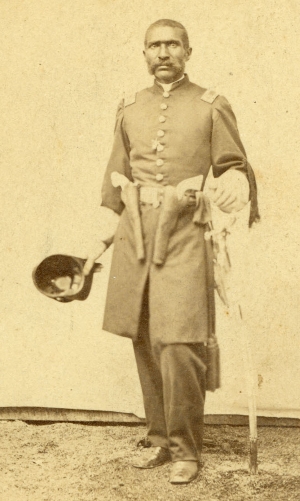
(Battle of Westport Visitor Center)
William D. Matthews was born a Maryland slave, so information about his early years remains elusive. By 1854, Matthews was a African American pioneer in Leavenworth, Kansas, a stop on the Underground Railroad. He opened a restaurant that soon became the head station on the underground railway system, with Matthews the “general passenger traffic manager.” As manager, he helped numerous runaways reach safety through the Leavenworth connection, and continued his underground work until he enlisted in the Union army on February 27, 1862.
From August and November 1862 on the behalf of Kansas Senator James H. Lane, Matthews recruited a company of 81 men to enlist in an African American regiment. There was an understanding between Lane and Matthews that Matthews would be commissioned as the captain of his company in the regiment. But the US War Department had not officially authorized the recruitment of Colored troops, they could not be mustered into service. By January 1863, Lane received authorization and mustered in the 1st Kansas Colored Infantry at Fort Scott, Kansas. But the request to commission African American officers was denied. Matthews felt betrayed and returned to Leavenworth.
Then in June 1864, Maj. Gen. Samuel R. Curtis received authorization to raise an African American artillery battery. Curtis asked Matthews bto ecome a recruiting officer for this battery and commissioned him a first lieutenant. By October 1864, the battery had only mustered in enough volunteers to man one section of two guns. Matthews had traveled to Fort Scott, Kansas, on a recruiting mission. When news of Price’s Confederate Army was heading for Kansas, Matthews helped prepare the defenses in Fort Scott. So, Matthews was not present when the Independent Battery, US Colored Light Artillery fought in the Battle of Westport. The section was commanded by 2d Lt. Patrick H. Minor, another of the battery’s black officers. After the war, Matthews returned to Leavenworth. Matthews was elected first Grand Master of the Kansas Prince Hall Masons and Grand Master of the National Grand Lodge of the Prince Hall Masons.
Spurgeon, Ian Michael. Soldiers in the Army of Freedom: The 1st Kansas Colored, The Civil War’s First African American Combat Unit, Kindle Edition.
Cunningham, Roger D. “Douglas’s Battery at Fort Leavenworth: The Issue of Black Officers during the Civil War.” Kansas History 23, no. 4 (Winter 2000): 200–217.
Braimah, Ayodale. “Matthews, William Dominick (ca. 1833-ca. 1910).” BlackPast.org Remembered and Reclaimed, November 11, 2017. http://www.blackpast.org/aaw/matthews-william-dominick-ca-1833-ca-1910.
Mattox, Joelouis. “Lt. William D. Matthews: The Sable Sword of Kansas.” Battle of Westport Visitor Center and Museum, n.d.