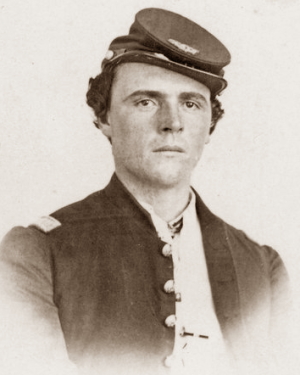
(Battle of Westport Museum)
Born in Ohio, Henry E. Palmer headed west to the gold field of Colorado when he was 18 years old. In 1861, Palmer went to Fort Leavenworth, Kansas, to volunteer for Federal service. Palmer mustered into service on August 1, 1861, as commissary sergeant in the 10th Kansas Infantry. The following year, Palmer mustered in as second lieutenant in Company A, 11th Kansas Cavalry. Five months later, Palmer was promoted to first lieutenant and became captain of his company on March 24, 1863.
During the fighting at Lexington on October 19, Palmer’s company was cut off from the rest of Blunt’s command. Palmer had to lead his company through Confederate-occupied Lexington and did not reach Blunt’s lines along the Little Blue until late at night. Thus, when the fighting at Little Blue River began Friday morning on October 21, Palmer was not quite ready to fight.
"About nine A. M., October 21, the enemy appeared. I had been awake but a few minutes and was trying to sew up a big rent in my pants, made in riding through the brush. I had to jump for my horse and see that my men were promptly in line of battle, and, having no time to put on my pants, threw them across my saddle and went into the fight. It was a sorry fight. They kept us busy for an hour or two, trying to prevent their crossing the Little Blue River. Under a sharp fire we ran a wagonload of hay into the bridge and set it on fire. But it was all to no particular effect, so far as stopping the enemy, for the stream was not a bad one to cross, there being fords near the bridge, above and below, and we soon felt the sting of the enemy’s bullets on our right and left flanks. We had to hustle to the rear, which we did in good order."
Later that morning, Palmer's company was ordered to go to the support of McLanin's Battery in danger of being overrun by the Confederates.
"About two and a half miles from where the first attack was made, we saw the Second Colorado battery of six fine Parrott guns crossing a field on our right as we were retreating. The guns were too heavy for the plowed land and the teams stalled. The rebel advance was within 400 or 500 yards of the battery. Quick work must be done to save the guns, worth a thousand men to us. Colonel Moonlight, commanding our brigade, came galloping down the line to my company. We were the rearguard. He ordered me to countermarch and charge the enemy with my eighty-eight men in a column of eight front."
On Saturday, October 22, Palmer's company spent most of the morning "cutting timber and constructing abbatis work, blocking the roads and trails and all the crossings of the Big Blue." Then when the Federals' position at Byram's Ford was flanked, Palemr fell back to Westport. The next day, Palmer's company was deployed with Col. Thomas Monlight's brigade on the the Federal right flank along Brush Creek.
In 1865, Captain Palmer served as quartermaster for the Powder River Expedition, a punitive expedition to put a stop to Native American raids along the Bozeman Trail. After the war, Palmer moved to Plattsmouth, Nebraska, worked in the grain trade and then the insurance business.
Kansas Adjutant General, Report of the Adjutant General of the State of Kansas, 1861-’65, 347.
Palmer, Henry E. “The Soldiers of Kansas. Company A, Eleventh Kansas Regiment, in the Price Raid.” In Transactions of the Kansas State Historical Society, 1905-1906, edited by George W. Martin, IX:431–43. Topeka, KS: State Print-ing Office, 1906.
Palmer, Henry E. “Powder River Indian Expedition of 1865.” In Civil War Sketches and Incidents, 59–109.
History Nebraska. “Henry E. Palmer and George H. Palmer,” January 25, 2011. https://history.nebraska.gov/collections/henry-e-palmer-and-george-h-palmer-rg3887am.