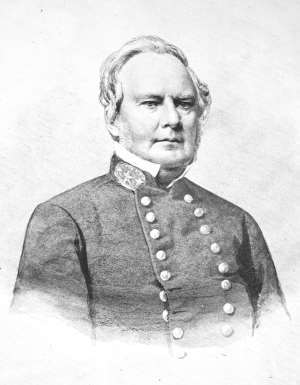
(Library of Congress)
Price was born in 1809 near Farmville in Prince Edward County, Virginia. In 1831, Price moved with his family to Fayette, Missouri and then a year later to Keytesville, Missouri. Working his farm in Keytesville, Price became a prominent tobacco planter. Price served in the Missouri State House of Representatives in the late 1830s and early 1840s and was elected as a US Congressman representing Missouri. Price resigned from being a congressman to serve in the Mexican American War. Price raised the Second Regiment of the Missouri Mounted Volunteer Cavalry and was elected its colonel on August 12, 1846. President James K. Polk promoted Price to brigadier general of volunteers on July 20, 1847. Following the war, Price was discharged on November 25, 1848, and returned to Missouri.
Back in Missouri Price returned to raising tobacco, becoming a slave owner in the process. Missouri elected him Governor and he served from 1853 to 1857. On February 28, 1861, Price was elected presiding officer of the Missouri State Convention, which would end up voting against secession.
Initially, Price was against secession for the state of Missouri. But that changed after May 10, 1861, and the Camp Jackson Affair. Missouri Governor Claiborne Fox Jackson, a southern sympathizer, had called out the state militia for training. They established "Camp Jackson" about 4 to 5 miles from the St. Louis Federal Arsenal. US Army Capt. Nathaniel Lyon, an ardent abolitionist, saw this as a threat to the federal arsenal and forced the militiamen to surrender to his Federal volunteer force. In marching the prisoners through St. Louis, a riot broke out and many of the prisoners were killed or wounded.
Price was outraged by what happened at Camp Jackson. Missouri Governor Jackson placed Price in command of the Missouri State Guard on May 11, 1861. On June 11, 1861, Price joined Missouri Governor Jackson to meet with now Brigadier General Nathaniel Lyon and Missouri Congressman Francis P. Blair, Jr. The purpose of the meeting was to work out their differences and calm the emotions on both sides. Lyon stormed out of the meeting, essentially declaring war on Jackson and the state of Missouri. As a result, Price's Missouri State Guard retreated with Lyon in pursuit.
Price led the Missouri State Guard in a series of engagements against Lyon's Union forces. The Battle of Boonville on June 17th resulted in a Union victory. Price continued moving south. Price temporarily left the Missouri State Guard to obtain reinforcements from the Confederates. Price formed an alliance with Confederate Brig. Gen. Benjamin McCulloch and the Arkansas State Militia. In August 1861, they moved against Lyon's Union Army of the West in the Battle of Wilson's Creek, which resulted in a Confederate victory.
After the Union Army of the West retreated to Rolla, Missouri, Price moved the Missouri State Guard north and engaged Union defenders in the Siege of Lexington (from September 13 to September 20, 1861). The Union defenders surrendered and Price gained control of the Missouri River Valley west of Arrow Rock. But Price was unable to keep control and had to move south. Union Maj. Gen. John C. Frémont was marching west to regain control of the Missouri River.
That fall, Governor Jackson called together a General Assembly session in Neosho, Missouri. Although it’s unlikely they had a quorum, the General Assembly passed an Ordinance of Secession on October 31, 1861.
In March of 1862, Price commanded his Missouri troops as part of the Confederate forces at the Battle of Pea Ridge in Arkansas. The result was a Union victory that solidified control of Missouri for the United States. Shortly after, Price resigned his commission from the Missouri State Guard and joined the CSA Army as a major general. Later that year, Price and his Missouri troops were sent east of the Mississippi River to reinforce General Albert Sydney Johnston. Although they arrived to late to participate in the Battle of Shiloh, Price did lead his soldiers as part of the Confederate forces in the Second Battle of Corinth in October 1862. This too ended in defeat for the Confederacy.
In 1863, Price requested and was transferred back to the Confederate Department of the Trans-Mississippi. In July 1863, Price commanded an infantry division under Lt. Gen. Theophilus H. Holmes in the Battle of Helena. The overall attack was poorly coordinated and resulted in a Union victory. Later that year, Holmes became ill and took a leave of absence. Price was placed in command of all Confederate forces in Arkansas.
In the summer of 1864, Price received approval to mount a cavalry raid into Missouri. The raid's purpose was to attract recruits, capture supplies, and draw Union forces from the eastern theater of the war, away from Petersburg and Atlanta. Although the raid initially succeeded in capturing large quantities of supplies, Price's Army of Missouri was decisively defeated at the Battle of Westport. He subsequently lost a series of battles and much of his captured supplies while retreating south from Westport. His retreat took him through the Indian Territory and Texas. After three months, Price finally returned to Arkansas in December 1864 with less than half the troops with which he had started the campaign.
At the end of the war, Price refused to surrender and went to Mexico. Price was a leader who worked to establish a Confederate exile colony named Carlota in Veracruz, Mexico. This colony failed and Price returned to Missouri, impoverished and in poor health. Sterling Price died of cholera while living in St. Louis and is buried in Bellefontaine Cemetery in St Louis, Missouri.
Bearss, Edwin C. The Battle of Wilson's Creek. Fourth Edition. Cassville: Wilson's Creek National Battlefield Foundation, 1992.
Brooksher, William R. Bloody Hill: The Civil War Battle of Wilson's Creek. Washington: Brassey's, 1995.
Buresh, Lumir F. October 25th and The Battle of Mine Creek. Kansas City: The Lowell Press, 1977.
Castel, Albert. General Sterling Price and the Civil War in the West. Baton Rouge : Louisiana State University Press, 1996.
Hess, Earl J., William L. Shea, William G. Piston, and Richard W. Hatcher. Wilson's Creek, Pea Ridge, and Prairie Grove: A Battlefield Guide, with a Section on Wire Road. Lincoln: Bison Books, 2006.
Hinton, Richard J. Rebel Invasion of Missouri and Kansas and the Campaign of The Army of the Border Against General Sterling Price in October and November 1864. Ottawa: Kansas Heritage Press, 1994
Lee, Fred L., Ed. Gettysburg of the West: The Battle of Westport, October 21-23, 1864. Shawnee Mission: Two Trails Genealogy Shop, 1996.
Monnett, Howard N. Action Before Westport 1864, Revised Edition
Piston, William G. and Richard W Hatcher III. Wilson's Creek: The Second Battle of the Civil War and the Mean Who Fought It. Chapel Hill: University of North Carolina Press, 2000.
Rolle, Andrew F. The Lost Cause: The Confederate Exodus to Mexico. Norman, OK: University of Oklahoma Press, 1992.