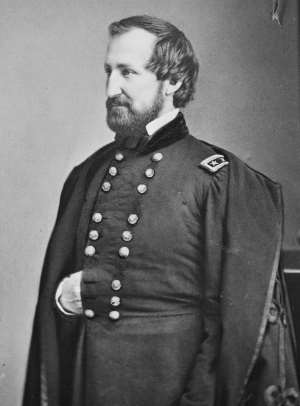
(Library of Congress)
William Starke Rosecrans was born on September 6, 1819 in Delaware County, Ohio, the son of a veteran of the War of 1812. Rosecrans attended the US Military Academy at West Point, graduating fifth in his class in 1842. Commissioned a Second Lieutenant of Engineers in the US Army Engineering Corps, Rosecrans spent only a year in the Engineering Corps before he was transferred to West Point to teach cadets as an assistant professor. Because of poor health, Rosecrans resigned his commission in 1853 and began a career in civil engineering. When the American Civil War began, Rosecrans volunteered for service and was appointed Chief Engineer for the Ohio Volunteers with a rank of Major. Then in May Rosecrans received an appointment as Brig. Gen. of Volunteers from the War Department.
On July 11, Brig. Gen. Rosecrans was in command of a brigade when Maj. Gen. George B. McClellan advanced into western Virginia to attack the Confederates at Rich Mountain. His first engagement ended in victory. McClellan sent a dispatch to General-in-Chief Winfield Scott to inform him of the victory.
We are in possession of all the enemy's works … have taken all his guns, a very large amount of wagons, tents, &c.–everything he had. A large number of prisoners, many of whom wounded. Several officers prisoners. They lost many killed. We have lost in all perhaps twenty killed and forty wounded, of whom all but, two or three in the column under Rosecrans, which turned the position. Mass of enemy escaped through the woods entirely disorganized.
Later that month McClellan was recalled to Washington to become US Army General-in-Chief. On July 25, Rosecrans replaced McClellan as commander of the Department of the Ohio. After McClellan was removed as General-in-Chief in a major reorganization, Rosecrans found himself without a command. In the summer of 1862, Rosecrans was transferred out west to serve in Maj. Gen. Henry W. Halleck’s Department of the Mississippi. In another reorganization, Rosecrans found himself under the command of Maj. Gen. Ulysses S. Grant. In September 1862 during the Battle of Iuka Rosecrans was supposed to attack Sterling Price and be supported by Grant, which for some reason did not happen. The issue went public, damaging the relationship between Rosecrans and Grant.
In October 1862, Lincoln promoted Rosecrans to Maj. Gen. and placed him in command of the Department of the Cumberland. In the Battle of Stones River near Murfreesboro, Tennessee, Rosecrans attacked the rebel forces commanded by General Braxton Bragg. Rosecrans continued campaigning against Bragg during the Tullahoma Campaign. But on September 19, 1863, Rosecrans was badly beaten during the Battle of Chickamauga Creek and retreated into Chattanooga where he was besieged by Bragg’s army. During the siege, President Abraham Lincoln reorganized the western theater. He combined three departments into the Department of the Mississippi and placed Grant in command of it all. Two days later, Grant relieved Rosecrans from command of the Army of the Cumberland and ordered him to “proceed to Cincinnati, Ohio, and report to the Adjutant-General of the Army by letter for orders.” As it turned out, Rosecrans only sat on the sidelines for a couple of months. In January 1864, President Lincoln decided he needed a change in Missouri, and so appointed Rosecrans to take command in Missouri. As the commander in Missouri, Rosecrans was not expected to have to fight major battles. But that all changed when Maj. Gen. Sterling Price invaded Missouri in the fall of 1864.
Roscrans received advance notice the Confederates were planning an invasion of Missouri. To prepare, Rosecrans ask for and recieved authorization to raise additional volunteer regiments for the defense of Missouri. Rosecrans also succeeded in getting the US War Depatment to divert two infantry divisions and one cavalry division under the command of Maj. Gen. Andrew J. Smith to Missouri. Once Price's army entered Missouri, Rosecrans ordered Missouri State Militia (MSM) Cavalry nder his command to converge on Jefferson City. Rosecrans ordered reinforcements under the command of Brig. Gen. Thomas Ewing Jr down to Fort Davidson in Pilot Knob, Missouri. A staunch defense agasinst the Confederate attack of the fort, delayed Price's advance for a few days. Rosecrans had recalled his second in command, Maj. Gen. Alfred Pleasonton, and ordered him to Jefferson City to assume command of the MSM Cavalry forces there. Once Price turned west, Rosecrans left General Ewing in command at St. Louis and took to the field to manage the defense of Missouri. Rosecrans was not present during the Battle of Westport, arriving in Independence late in the day on October 23, 1864. After authorizing Pleasonton to coooperte in the pursuit of Price's retreating army, Rosecrans return to his headquarters in St. Louis.
Shortly after the end of Price’s Missouri raid, Rosecrans was replaced in Missouri by Maj. Gen. Grenville Dodge. After the war Rosecrans resigned from the regular army in 1887, retiring with the rank of brigadier general. Rosecrans moved to California, helped found the Southern Pacific Railroad, and served two terms in Congress.
More, David G. William S. Rosecrans and the Union Victory: A Civl War Biography. Jefferson, NC: McFarland & Co., 2014.
Titterington, Dick. A Day Late and a Dollar Short: The Fate of A. J. Smith’s Command during Price’s 1864 Missouri Raid. Overland Park, KS: Trans-Mississippi Musings Press, 2014.
Titterington, Dick. The Battle of Westport, October 21–23, 1864: A Driving Tour of Battle Sites in Kansas City, Independence, and Northeastern Jackson County, Missouri. Overland Park, KS: Trans-Mississippi Musings Press, 2019.
Lamers, William M. The Edge of Glory of General William S. Rosecrans, U.S.A. New York: Harcourt, Brace & World, Inc., 1961.
Taggart, Joseph. Biographical Sketches of the Eminent American Patriots, Charles Carroll, of Carrollton; Roger Brooke Taney; William Starke Rosecrans; John Barry; Philip Henry Sheridan, and a Sketch of the Early History of Maryland. Kansas City: Burton Company, 1907.