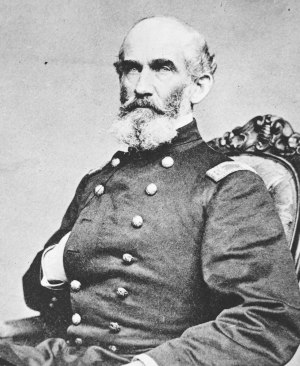
Born in Pennsylvania in 1815, Andrew Jackson Smith graduated from West Point and joined the 1st US Dragoons. When the Civil War began, Smith was a major in the 1st US Cavalry stationed in California. Smith mustered into volun-teer service as colonel of the 2d California Cavalry.
General Smith was in command of the Right Wing, XVI Army Corps in the Army of the Tennessee when it was detached for service in Louisiana the Red River Campaign. On their way to rejoining Sherman in Tennessee, Smith's command was diverted to Missouri to counter Price's 1864 invasion of that state. While a small number of units from his command participated in the Battle of Pilot Knob, Smith was not able to deploy his infantry against Price's Confederate army once they turned west. However, Smith's presence likely was a major reason Price chose not to attack St. Louis. Following the Battle of Westport, in which Smith's command did not participate, Smith was ordered to rejoin the Army of the Tennessee. His command arried in time to participate in the Battle of Franklin.
Smith rose to the rank of major general, finishing the war as commander of the XVI Army Corps. After the war, Smith stayed in the army with the permanent rank of colonel, commanding the 7th US Cavalry fighting Native Americans out west. Smith left the army in 1869 and was appointed by President Ulysses S. Grant to be Postmaster for St. Louis, Missouri.
Titterington, A Day Late and a Dollar Short, 1–2, 92.