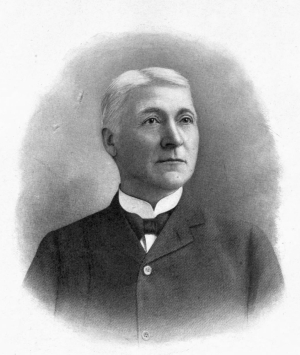
Born in Ohio, Charles H. Smith was living in Mt. Pleasant, Iowa, when he enlisted as a private on Spetember 1, 1862, in Company C, 4th Iowa Cavalry. In August 1863, Col. Edward F. Winslow was ordered to take his brigade, including the 4th Iowa Cavalry, on an expedition to Grenada, Mississippi. Unfortunately Private Smith was tagged to go with Cpl. James H. Davidson in serach of frying pan. I'll let Sgt. Maj. William F. Scott tell the story.
"At Grenada, the command remaining in camp one day, a mess of C thought it a good time to find a frying-pan or other vessel for cooking flapjacks. Charles H. Smith ... and James H. Davidson were detailed by their messmates to look for the treasure. Leaving their horses to rest, they mounted mules, rode into Grenada, and went to all the stores and a number of private houses, but without success. Then they rode out of the town eastward, of course supposing themselves still to be within the picket line. They had hardly got beyond the town, with eyes upon a house where they hoped to find the frying-pan, when from the bushes they heard the sharp order 'Halt! Surrender!' A party of rebels, about twenty, who had been concealed near the road, now stood up and presented shotguns and rifles at short range. On those slow mules and at that distance there was no hope of escape for the Yankees. They surrendered."
Several days later Private Smith managed to escape, stealing the Confederate captain's horse for his getaway. Six days, five nights and 200 miles later, Smith found his way back into Union lines and rejoined the regiment in Memphis, Tennessee, on August 29, 1863. Unfortunately, Corporal Davidson was not so fortunate. Davison "spent fifteen months in prisons and prison pens, in Mobile, Richmond, Belle Isle, Andersonville, and Millen, half-clad, half-starved, and most of the time without shelter or blanket."
During Price's 1864 invasion of Missouri, Smith fought in Independence, at the Big Blue River (Byram's Ford), Mine Creek, Little Osage River, and at Charlot's Farm. Smith was promoted to 6th sergeant on May 15, 1864. Smith was commssioned a second lieutenant on May 19, 1865 and mustered out of the service with his company.
Smith was much honored since the war by his comrades and has filled important positions in the Grand Army of the Republic. He was three times the commander of McFarland Post and was once elected Department Commander of Iowa, in 1889. Smith worked to promote legislation in behalf of the Iowa Soldiers’ and Sailors’ Monument. Smith ran a manufacturing business.
Griff. “1863: Diary of Charles H. Smith, Co. C, 4th Iowa Cavalry.” Spared & Shared 19, July 3, 2019. Link.
Scott, William F. The Story of a Cavalry Regiment. The Career of the Fourth Iowa Veteran Volunteers from Kansas to Georgia, 1861-1865. New York: G. P. Putnam’s Sons, 1893.
Scott, William F. Roster of the Fourth Iowa Cavalry Veteran Volunteers, 1861-1865 : An Appendix to “The Story of a Cavalry Regiment.” New York: J.J. Little, 1902.
Iowa Adjutant General. Roster and Record of Iowa Soldiers in the War of the Rebellion, Vol. IV. Des Moines, IA: Emory H. English, State Printer, 1910.
Weed, Cora Chaplin. Handbook for Iowa Soldiers’ and Sailors’ Monument. Des Moines, IA: Iowa Council and Monument Commission, 1898.