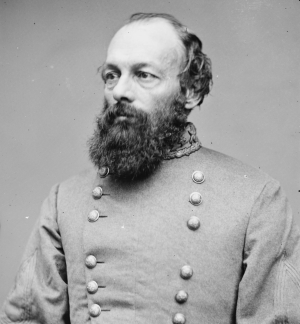
Born in Florida, Edmund Kirby Smith graduated from West Point in 1845 and was commissioned a second lieutenant in the 5th US Infantry. Smith fought in the Mexican-American War and received two brevet promotions for his ser-vice. After the war, Smith was a captain in the 2d US Cavalry and returned to West Point as an instructor. When the American Civil War started, Smith resigned his commission and enrolled in the Confederate Army as a major in artillery. A couple of months later, Smith was promoted to brigadier general and assigned command of a brigade in the Army of the Shenandoah. After recovering from a wound received in the First Battle of Bull Run, Smith returned to service with the rank of major general in the Army of Northern Virginia. In the fall of 1862, Smith was promoted to lieutenant general and assigned to corps command in the Army of Tennessee. In January 1863, Smith was assigned to command the Confederate Trans-Mississippi Department. Promoted to general in February 1864, Smith was the overall commander during the ill-fated Union Red River Campaign. On August 3, 1864, Smith ordered Maj. Gen. Sterling Price to invade Missouri.
"You will make immediate arrangements for a movement into Missouri, with the entire cavalry force of your district. … You will scrupulously avoid all wanton acts of destruction and devastation, restrain your men, and impress upon them that their aim should be to secure success in a just and holy cause and not to gratify personal feeling and revenge. Rally the loyal men of Missouri, and remember that our great want is men, and that your object should be, if you cannot maintain yourself in that country, to bring as large an accession as possible to our force … Make Saint Louis the objective point of your movement, which, if rapidly made, will put you in possession of that place, its supplies, and military stores, and which will do more toward rallying Missouri to your standard than the possession of any other point. Should you be compelled to withdraw from the State, make your retreat through Kansas and the Indian Territory, sweeping that country of its mules, horses, cattle, and military supplies of all kinds."
After surrendering in June 1865, Smith went into exile in Mexico and Cuba. Smith returned to the United States toward the end of 1865 and worked in the telegraph industry and education.
OR s1 v41 p2, 1040-1041.
Parks, Joseph H. General Edmund Kirby Smith C.S.A. Baton Rouge, LA: Louisiana State University Press, 1982.
Wikipedia. “Edmund Kirby Smith,” June 16, 2019. Link.