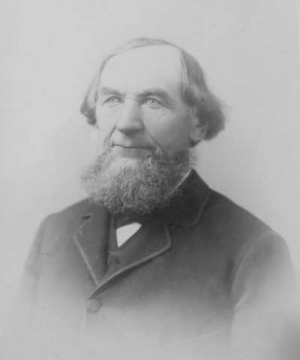
(Battle of Westport Museum)
George Thoman was born on November 13, 1819 in the village of Colmar which was near Ingersheim, Alsace, France. George had a brother Matthew (Matthias) who had come to America and settled in Riverside, Iowa sometime prior to 1854. In 1854 George Thoman, his wife and four sons came to America settling in Riverside where his brother and wife lived. The family moved west from Riverside, Iowa to Missouri in 1856, and settled on a 90-acre farm near what is today the southeast comer of 55th and Prospect Avenue in Kansas City. Prospect Avenue was at this time was called the Harrisonville Road. It was a heavy traffic road. It was also outside and somewhat isolated from the “nearby cities” of Westport and Kansas City.
Fast forward to late October 1864. George Thoman is about to turn 45 years old. After the Federals pulled back north of Brush Creek on October 22, Thoman found his farm easy pickings for Confederate foraging parties. Legend has it some soldiers came to his farm and helped themselves to, among many other items, a pregnant mare. Thoman told them the mare was close to foaling and therefore of no use to them, but they took the mare anyway. Thoman was certain they were Confederates.
As he skirted the fighting, searching to no avail for his mare, Thoman must have gotten some sense of how the battle was progressing. He knew something of value to the Federals. He went looking for somebody in charge. If he couldn’t get his mare back, George Thoman would get even.
Thoman explained to General Curtis there was a little-known road, more of a path really, following a ravine formed by Swan Creek. This path went from north to south and reached to present-day 55th Street. Curtis believed Thoman’s information. He decided to take his escort along with the 9th Wisconsin Battery and follow George Thoman. They headed west until they came to the ravine which ran to the south. Unseen by the Confederates fighting up on top of the plateau, Thoman led Curtis around to the left flank of Shelby’s lines. There Curtis ordered the artillery to unlimber and open fire on the Confederates.
Always the politician, Curtis was melodramatic in his official report of this turn in events. Thoman must have looked older than his 45 years, because Curtis called him a “75-year old patriot.”
"I was directed by an old man, a Missouri patriot of seventy-five years, through a narrow defile to Brush Creek with Dodge’s bat-tery and other forces. With trembling, sinking steps the old man directed us to a position where we immediately began to demon-strate against the enemy that occupied the inclined plain and wooded heights on the south of Brush Creek. The weary veteran refused to ride but sunk down with delight and exhaustion when he saw the success of our guns. Like many other brave Missouri-ans of that day he saw the rebellion vanishing before him and his home and country free."
Ironically his final resting place is about 150 feet east of that where General Joseph O. Shelby is buried in Forest Hill Cemetery-the man he helped defeat that day in Westport.
Lee, Fred L. “Gone but Not Forgotten: George Thoman, 1819-1907.” Kansas City Genealogist 39, no. 2 (Fall 1998): 3–19.
Monnett, Howard N. Action Before Westport, 1864. Boulder, CO: University Press of Colorado, 1995.
OR s1 v41 p1, 486.
Titterington, Dick. The Battle of Westport, October 21–23, 1864: A Driving Tour of Battle Sites in Kansas City, Independence, and Northeastern Jackson County, Missouri. Overland Park, KS: Trans-Mississippi Musings Press, 2019.