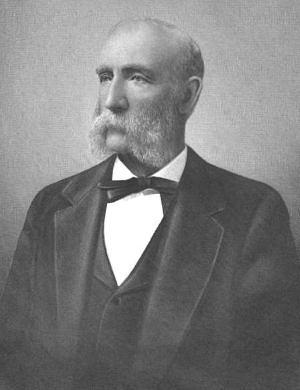
(Kansas: A Cyclopedia of State History, Vol. 3 by Blackmar)
Born in Indiana, George W. Veale went to college for two years and then worked as a clerk in a dry goods store. Veale was married in 1857 and soon relocated to Quindaro, Kansas, where he started a merchandizing business. Soon thereafter, Veale moved his business operations to Topeka, Kansas. In July 1861, Veale was commissioned captain of Company A, 6th Kansas Cavalry and was promoted to major five months later. Veale resigned his commission in 1863, but reentered service as colonel of the 2d Kansas State Militia in October 1864.
On October 22, 1864, Veale was ordered to deploy his regiment of around 300 militia at Russell's Ford on the Big Blue River. They were the right flank of the Federal defenses along the river. Col. Veale described the October 22 events at the ford in his official report.
"On the morning of October 21, I received orders from General [Melville S.] Grant to move with my command to the crossing of the Blue on the Kansas City and Hickman Mills Road, about four miles from the Kansas state line, which order I complied with, camping on the Blue that night. …
"[Early in the morning] a messenger arrived from General [Samuel Ryan] Curtis with a dispatch stating that the enemy was moving in strong columns up the Blue and directing him (General Grant) to send scouts to Hickman Mills to see if the enemy was moving south, on the Hickman Mills Road, and report every thir-ty minutes.
"I was asked by General Grant to take the battalion of my own regiment, the Second, and make the reconnaissance. I moved off immediately and met some troops coming from there as I went over, but saw nothing of the enemy.
"About one mile south of the Blue, at a point where I could overlook the whole country, I ordered a halt and fed my horses. In a very few minutes the General and his staff rode up. … General Grant directed me to move back to the north side of the Blue, which I did, the General and staff riding in advance.
"Soon after crossing the stream we met a messenger who told us that fighting was going on up in the Prairie."
"Up in the prairie" was the regiment's one-gun battery about to be overrun by Confederate cavalry. Veale got his militia into line of battle and fired off a volley causing the Confederates to pull back. Brig. Gen. Melvin S. Grant sent couriers to find Maj. John M. Laing and the 21st KSM, still east of Russell’s Ford on patrol, and have them rush here to support the 2d KSM. But there were to be no reinforcements for the 2d KSM.
To make matters worse, Col. Sydney D. Jackman arrived on the scene with his brigade of Confederate cavalry. A second attack was resisted by the Kansas militiamen. All the time Burns was firing canister into the Confederate ranks, causing many casualties. Jackman prepared his men for another cavalry charge and this time broke the enemy line. The Kansas militiamen scattered. More than two-thirds of the 2d KSM were killed, wounded and captured. The rest, including General Grant and Colonel Veale, managed to withdraw down to Russell’s Ford where they met up with the 21st KSM.
There was additional skirmishing until darkness fell and the Confederates withdrew. Grant managed to lead what was left of his shattered command down to New Santa Fe and then back to Olathe, Kansas.
2d KSM Quartermaster Samuel J. Reader was captured at Mockbee Farm but later described Veale's actions during the fight.
There were rebels on the prairie. … A line was being formed on the little swell of ground in the field, just 300 yards from us. It was done with considerable rapidity. … The line on the ridge, in a few moments became mottled by white puffs of smoke, and a shower of bullets came whizzing about our ears like a swarm of angry hornets. They were sure enough rebels, that would send us such tokens of deadly hostility. … For a time the exchange of shots was lively on both sides. At one time our line became disor-dered, and it threatened to break. I saw Col. Veale ride up and strive by voice and gesture, to restore steadiness to the wavering mass. I heard him cry out in a tone of stern entreaty: “For God’s sake, men, keep our places in line!”
After the war, Veale entered into the railroad business and was one the incorporators of the Atchison, Topeka & Santa Fe railroad. Veale organized the Bank of Topeka and served several terms in the Kansas state legislature.
Blackmar, “George W. Veale.” In Kansas: A Cyclopedia of State History, Vol. III Part 1, 352–55.
Kansas Adjutant General, Report of the Adjutant General of the State of Kansas, 1861-’65, 164-165.
Kansas Adjutant General, Muster Rolls, Kansas State Militia, Volume 1, 53.
Titterington, Dick. The Battle of Westport, October 21–23, 1864: A Driving Tour of Battle Sites in Kansas City, Independence, and Northeastern Jackson County, Missouri. Overland Park, KS: Trans-Mississippi Musings Press, 2019.
Veale, George W. “George W. Veale to George W. Dietzler,” October 30, 1864. https://www.kansasmemory.org/item/225895.