Search:
Powered by
Website Baker
Brig. Gen. M. Jeff Thompson
Shelby's Iron Brigade, Shelby's Division, Army of Missouri (CSA)
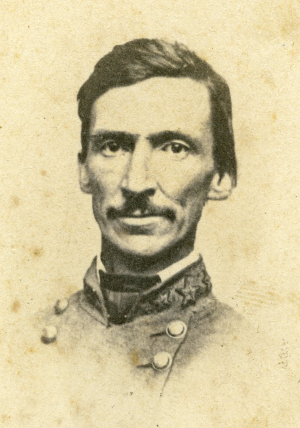
(Wilson's Creek National Battlefield)
Meriwether Jeff Thompson was born at Harpers Ferry, Virginia, now West Virginia into a family with a strong military tradition on both sides. Thompson received basic training in military tactics in Charleston, South Carolina, but was not appointed to a military academy. Following his education, he found employment as a store clerk in a few Virginia and Pennsylvania towns. He moved to Liberty, Missouri in 1847 and St. Joseph the following year, beginning as a store clerk before taking up surveying and serving as the city engineer. He later supervised the construction of the western branch of the Hannibal & St. Joseph Railroad. He married Emma Hayes in 1848. Thompson served as St. Joseph mayor from 1857–1860. He presided over the ceremony inaugurating the first ride of the Pony Express on April 3, 1860. Thompson also gained national attention in May, 1861, when he cut down a union flag from the St. Joseph post office flag pole and threw it down to an angry crowd of southern sympathizers who shredded it to pieces.
Thompson was a colonel in the Missouri state militia at the outbreak of the Civil War. In late July 1861, he was appointed brigadier general of the First Division, Missouri State Guard. He commanded the First Military District of Missouri, which covered the swampy southeastern quarter of the state from St. Louis to the Mississippi River. Thompson's battalion soon became known as the "Swamp Rats" for their exploits. He gained renown as the "Swamp Fox of the Confederacy." Although Thompson frequently petitioned for the Confederate rank of brigadier general it was never granted. His brigadier rank came from his Missouri State Guard service.
Thompson was reassigned to the Trans-Mississippi region. There, he engaged in a number of battles before returning to Arkansas in 1863 to accompany Gen. John S. Marmaduke on his raid into Missouri. In August 1863, Thompson was captured in Pocahontas, Arkansas. Thompson spent time in St. Louis' Gratiot Street prison, as well as at the Fort Delaware and Johnson's Island prisoner-of-war camps. remained in captivity until the summer of 1864 when he was exchanged. After stopping in Richmond, Thompson proceeded west to join Price's Army of Missouri. He reached the Confederate army near Jefferson City in October and was assigned to command Shelby's Iron Brigade, whose previous commander, Col. David Shanks, had been mortally wounded on October 6, 1864, in the fighting near Jefferson City.
General Thompson's brigade was detached and sent to attck Sedalia, Missouri, for the purpose of capturing supplies there. His attack was successful and he returned to Price's army. On October 21, the Iron Brigade reinforced the Confederate attack at the Little Blue River. On October 22, Shelby sent Thompson to gain control of Byram's Ford, although the attack stalled until the Federal position was flanked and had to fall back. Then Thompson's men fought a running battle all the way back to the Kansas state line. On October 23, Thompson led his bridgade during the fighting just south of Brush Creek, only withdrawing when Shelby's left flank was attacked by Federal artillery.
During the retreat from Westport, Thompson's brigade fought a rear guard action at the Little Osage and Marmaton Rivers following the Confederate disaster at Mine Creek. Then again, Thompson's brigade was called to fight at Newtonia, Missouri, when the Federal advance under the command of Maj. Gen. James G. Blunt caught up to the Confederates. They successfully beat back the Federal attack and the Confederates continued their march south, crossing the Arkansas River in the Indian Territory (present-day Oklahoma).
Thompson agreed to surrender his command at Chalk Bluff, Arkansas on May 11, 1865. About a third of his men refused to surrender. Shelby's Missouri Brigade, along with elements of Green's and Jackman's Missouri Brigades, lit out for Mexico. Some Missouri units disbanded rather than surrender their colors. Many men simply went home.
After the war, Thompson moved to New Orleans, where he returned to civil engineering. He designed a program for improving the Louisiana swamps, a job that eventually destroyed his health. He returned to St. Joseph, Missouri in 1876 where he succumbed to tuberculosis. He is buried in Mount Mora Cemetery in St. Joseph, Missouri.
References
-
Monnett, Howard N. Action Before Westport, 1864. Boulder, CO: University Press of Colorado, 1995.
-
OR s1 v41 p1, 663-671.
-
Thompson, M. Jeff. The Civil War Reminiscences of General M. Jeff Thompson. Edited by Donal J. Stanton, Goodwin F. Berquist Jr., and Paul C. Bowers. Dayton, OH: Morningside House, Inc., 1988.